BOTOX® for Chronic Migraine
BOTOX® (onabotulinumtoxinA) is an FDA-approved preventive treatment for adults with chronic migraine. Given as a set pattern of small injections around the head and neck every 12 weeks, it aims to reduce the number of headache days you have each month. At Spine & Rehabilitation Medicine Associates in Pomona, NY, the injections are performed by Dr. Samuel Rosenberg, DO for patients from Rockland and Bergen counties.
Looking for botulinum toxin for tight muscles after a stroke, brain injury or spinal cord injury? See our page on Botulinum Toxin Injections for Spasticity.
What is chronic migraine?
Chronic migraine means headache on 15 or more days a month for more than 3 months, with migraine features on at least 8 of those days. The FDA label for BOTOX describes the approved use as “prophylaxis of headaches in adult patients with chronic migraine (≥15 days per month with headache lasting 4 hours a day or longer).” Prophylaxis means prevention: the aim is fewer headache days over time, not relief of a headache that has already started.
BOTOX is not approved for episodic migraine. The label states that its safety and effectiveness have not been established for the prophylaxis of episodic migraine, which is 14 headache days or fewer per month. If you have fewer headache days than that, other preventive treatments may be a better fit, and we can help you sort that out.
How it works
BOTOX blocks the release of chemical messengers from nerve endings. When injected into the muscles of the head and neck at the approved sites, it reduces activity at those nerve endings for a few months. Exactly how that translates into fewer headache days is still being studied, but the effect was shown in the clinical studies described below.
The treatment pattern
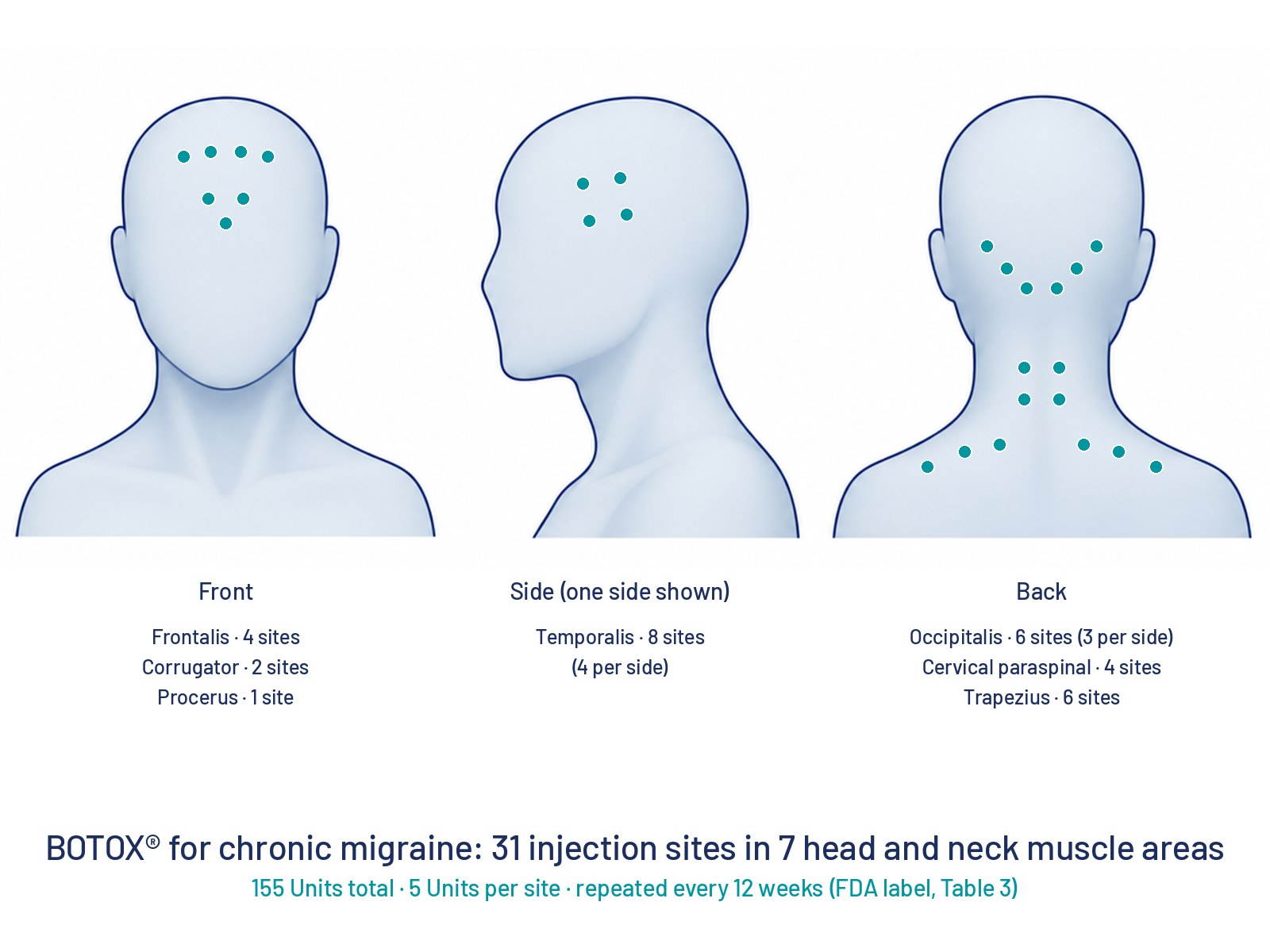
The approved treatment follows a fixed pattern from the FDA label: a total of 155 Units given as 31 small injections of 5 Units each, divided across 7 muscle areas of the head and neck. Except for the single midline injection between the brows, every area is injected on both sides, half the sites on the left and half on the right. The recommended re-treatment schedule is every 12 weeks. The diagram at the top of this page shows the 31 sites: frontalis 4, corrugator 2, procerus 1, temporalis 8 (4 per side), occipitalis 6 (3 per side), cervical paraspinal 4 and trapezius 6; the side view shows one side.
| Head/neck area | Dose (number of sites) |
| Frontalis (forehead) | 20 Units divided in 4 sites |
| Corrugator (between the brows) | 10 Units divided in 2 sites |
| Procerus (bridge of the nose) | 5 Units in 1 site |
| Occipitalis (back of the head) | 30 Units divided in 6 sites |
| Temporalis (temples) | 40 Units divided in 8 sites |
| Trapezius (upper shoulders) | 30 Units divided in 6 sites |
| Cervical paraspinal muscle group (back of the neck) | 20 Units divided in 4 sites |
| Total | 155 Units divided in 31 sites |
What the studies showed
BOTOX was evaluated in two randomized, 24-week, placebo-controlled studies in adults with chronic migraine, with injections every 12 weeks for two treatment cycles. In the FDA label’s own words, at week 24 the change from baseline in the number of headache days per 28 days was −7.8 with BOTOX versus −6.4 with placebo in Study 1, and −9.2 with BOTOX versus −6.9 with placebo in Study 2. The total hours of headache on headache days fell by 107 (BOTOX) versus 70 (placebo) in Study 1, and by 134 versus 95 in Study 2. Results vary from person to person, and some people do not respond.
Who is a good candidate
BOTOX for chronic migraine may be appropriate for adults who:
- Have headache on 15 or more days a month, for more than 3 months, with migraine on at least 8 of those days
- Want a preventive treatment, often after other preventive medicines have not helped enough or caused side effects
- Can keep a headache diary and return every 12 weeks
It is not right for everyone. BOTOX is not approved for episodic migraine or for children with migraine. You should not receive it if you are allergic to any botulinum toxin product or any ingredient in the formulation, or if you have an infection at a planned injection site. Tell us before treatment if you:
- Have a nerve or muscle condition such as myasthenia gravis, Lambert-Eaton syndrome or ALS, which raises the risk of serious side effects, including severe weakness and trouble swallowing or breathing
- Are pregnant, plan to become pregnant, or are breastfeeding. Based on animal data, BOTOX may cause fetal harm, and it is not known whether it passes into breast milk
- Have received any botulinum toxin product in the last four months
- Take injected antibiotics such as aminoglycosides, muscle relaxants, anticholinergic medicines, or other drugs that affect nerve-to-muscle signaling, which can increase the toxin’s effect
What to expect
Your first visit
Dr. Rosenberg reviews your headache history and your headache diary to confirm the diagnosis of chronic migraine, goes over the medicines you have tried, and confirms that the treatment is appropriate for you.
The injections
Dr. Rosenberg performs the injections himself, following the 31-site pattern in the label with a very fine needle. The visit is short, and you can drive home and return to your normal day afterward.
Follow-up
This is a preventive treatment, so you will not feel it work the way you feel a pain reliever. Keep your headache diary between visits so we can see how your headache days change. The label recommends re-treatment every 12 weeks, and the clinical studies measured results after two cycles, so it can take more than one cycle to judge the benefit.
Risks and side effects
Most side effects are mild and pass on their own. In the two clinical studies described in the FDA label, the side effects reported more often with BOTOX than with placebo included neck pain, headache, migraine, drooping of an eyelid, facial weakness, muscle stiffness, muscle weakness, muscle pain and pain at the injection sites. The label also notes that severe worsening of migraine requiring hospitalization occurred in approximately 1% of BOTOX-treated patients, usually within the first week after treatment, compared to 0.3% of placebo-treated patients. Allergic reactions are rare but possible.
Important safety information. BOTOX carries an FDA Boxed Warning for distant spread of toxin effect. The effects of botulinum toxin may spread from the area of injection to other parts of the body, causing symptoms such as general weakness, double vision, drooping eyelids, hoarseness, trouble speaking, loss of bladder control, and trouble swallowing or breathing. These symptoms can appear hours to weeks after an injection. Swallowing and breathing difficulties can be life threatening. If you have any trouble swallowing, speaking or breathing after treatment, seek medical care right away. For complete information, read the FDA-approved prescribing information and Medication Guide for BOTOX.
Insurance
BOTOX for chronic migraine is often covered by Medicare and commercial plans when the plan’s criteria are met, such as a documented diagnosis of chronic migraine, a record of your headache days and a record of the preventive medicines you have tried. Most plans require prior authorization. We will help check your coverage before you schedule.
Frequently asked questions
How do I know if I have chronic migraine and not episodic migraine?
Chronic migraine means headache on 15 or more days a month for more than 3 months, with migraine features on at least 8 of those days. Episodic migraine is 14 or fewer headache days a month. A headache diary kept for a month or two is the best way to tell, and we review it with you at your first visit.
Is BOTOX approved for episodic migraine?
No. The FDA label states that the safety and effectiveness of BOTOX have not been established for the prophylaxis of episodic migraine, which is 14 headache days or fewer per month. If that describes you, other preventive treatments exist, and we can help you find the right fit.
Who gives the injections?
Dr. Samuel Rosenberg, DO, performs the chronic migraine injections himself at our Pomona, NY office, following the standard 31-site pattern in the FDA label.
How many injections are there, and does it hurt?
The FDA-approved pattern is 31 small injections across 7 muscle areas of the head and neck, 5 Units each, for a total of 155 Units. The needle is very fine. Most people describe brief pinches, and the visit is short.
How soon will it work, and how often do I need it?
This is a preventive treatment, so the goal is fewer headache days over time, not relief of a headache that has already started. The label recommends re-treatment every 12 weeks, and in the clinical studies results were measured after two treatment cycles. Many people need more than one cycle to judge the benefit.
Does BOTOX cure migraine?
No. It is a preventive treatment that reduces headache days for a period of time and then wears off. It works alongside your other headache care, such as acute medicines and trigger management, not instead of it.
Ready to talk?
Call (845) 709-8555 to schedule a visit at our Pomona, NY office or to ask whether BOTOX for chronic migraine may be right for you.




.webp)